
What follows was written to do two things at once: half explain the ideas behind the Kavala Heli Time Trial—the low ceiling, the passengers, the tight route and the pressure to keep moving—and half develop those ideas into an in-world history. It gives the mission a little atmosphere: a race that began as a bad decision, acquired rules by accident, and somehow became a civic tradition. The Altis Rotor Club disputes almost every detail. Naturally, they keep telling the story.
A Brief History of the Kavala Heli Time Trials
Kavala has never been a quiet city. Years of war, occupation, insurgency and general Altian unpleasantness left their mark on its streets. Buildings were scarred, neighbourhoods changed hands more often than some of the local bars, and an entire generation became accustomed to gunfire, checkpoints and military helicopters passing low enough to rearrange the washing.
Then, somewhat inconveniently for certain people, peace broke out. For most of Kavala this was considered excellent news. For a small collection of helicopter pilots, it presented something of a problem.
These were men who had spent years flying through valleys, between buildings and into landing zones where sensible people had already decided not to be. They had grown accustomed to low-level flying, hard landings, questionable maintenance and bullet holes in their fuselage.
Peace offered fewer opportunities for this sort of thing. There were jobs, of course. Charter work. Sightseeing flights. Agricultural contracts. Transporting wealthy tourists to places they could easily have reached by car. None of it scratched the itch.
As the legendary Cletus “Collective” McGraw would later put it:
“Turns out peace is mostly paperwork.”
The Bet
The accepted story of how the Kavala Heli Time Trials began comes from the Altis Rotor Club. The Altis Rotor Club disputes almost every detail of this story. This has never stopped them telling it.
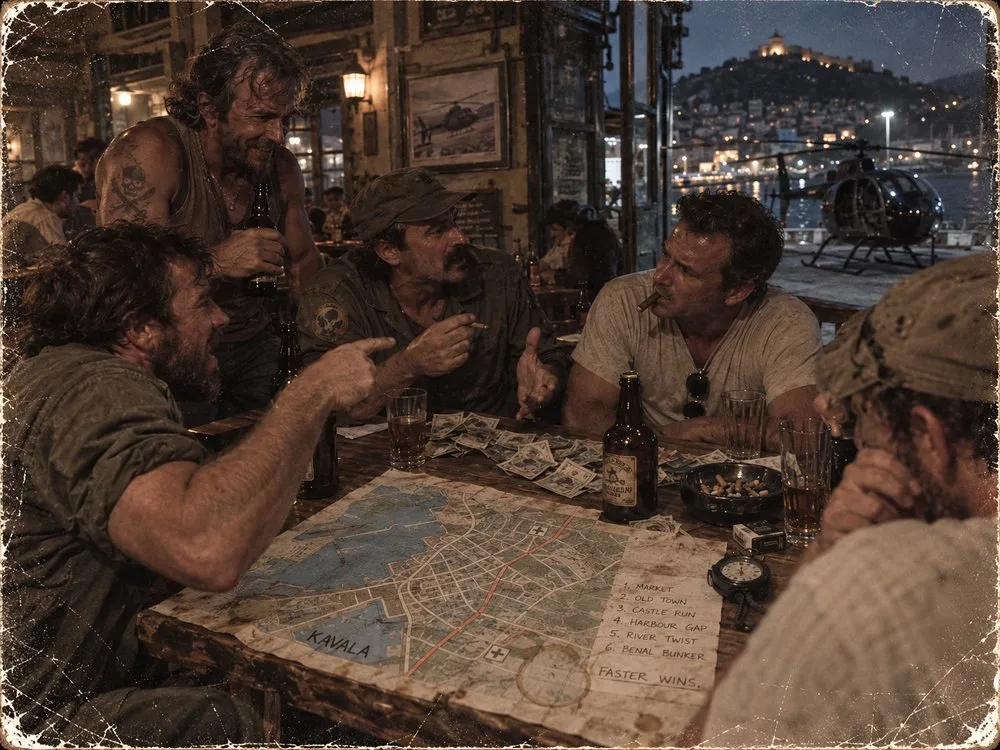 The first course was reportedly drawn on the back of a drinks menu. “Faster wins” was the only part everyone agreed on.
One evening, several members of the club were drinking in a harbour-side bar in Kavala and discussing flying. “Discussing” may be generous. By most accounts they were shouting. They argued about who was the best helicopter pilot on Altis. This quickly became an argument over who could fly lowest, who could fly fastest, who had completed the most dangerous extraction, and who had once passed between two apartment buildings with the least remaining paint.
At some point, Cletus McGraw reportedly claimed he could cross Kavala in a helicopter faster than anyone else at the table. Someone suggested that simply flying over the city hardly proved anything. Cletus replied that he had never said anything about flying over it. The challenge changed. The route would go through Kavala. Below the rooftops.
A second pilot insisted he could do it faster. A third began taking bets. Someone found a stopwatch. Someone else found another round of drinks. And at some point in the early hours, somebody acquired a Hummingbird. The ownership of that particular aircraft remains unclear.
When asked about it years later, McGraw reportedly answered:
“It had fuel in it.”
The first course was drawn on the back of a drinks menu. It ran from the outskirts of the city, through several major streets, past the church, down toward the harbour and back through central Kavala. The pilots immediately began arguing about altitude. Going over buildings, everyone agreed, would defeat the point. Eventually somebody proposed a maximum altitude of ten metres. It became the most important rule in the history of the event.
The second-most important rule was apparently added several drinks later:
Every aircraft must carry four passengers.
Several explanations have been offered over the years. Some claim the passengers were supposed to prove the pilot could handle a fully loaded aircraft. Others insist they were there as independent witnesses. One early account says somebody simply pointed out that racing a Hummingbird alone looked “a bit easy.” Whatever the reason, the rule stuck.
Shortly before sunrise, the first pilot climbed into the Hummingbird. Four other men climbed onto the benches.
There were no officials, barriers, medical crews or marshals. There was no permission from the city. There was, however, a stopwatch.
The First Time Trial
The first run attracted perhaps twenty spectators, most of whom had followed the pilots out of the bar. The second attracted considerably more. By the fifth, word had spread. A helicopter screaming through narrow city streets at several times the legal speed limit turns out to be surprisingly effective advertising.
Residents appeared on balconies. Shopkeepers came outside. Drivers abandoned their cars. Children climbed onto rooftops. Bar owners moved tables into the street. By mid-morning, hundreds of people had gathered along the improvised course.
They quickly learned the rules and, most importantly, they learned about the ten-metre ceiling. One nervous competitor climbed sharply to clear a row of buildings and was greeted by a wall of boos from several hundred spectators. He descended immediately and the crowd cheered. Another tradition was born.
The ten-metre ceiling has been part of the Kavala Heli Time Trials ever since. Today it is enforced by severe time penalties. The spectators consider this unnecessary and continue to enforce it themselves. Any pilot who climbs above the ceiling can expect boos, jeers and accusations of cowardice from people who are themselves standing comfortably on the ground. Some competitors have thrown away otherwise excellent runs simply because being booed through half of Kavala proved more embarrassing than taking the penalty.
Veteran pilot Chet “Send It” Mulligan once explained the rule in simpler terms:
“If you wanted altitude, you entered the wrong race.”
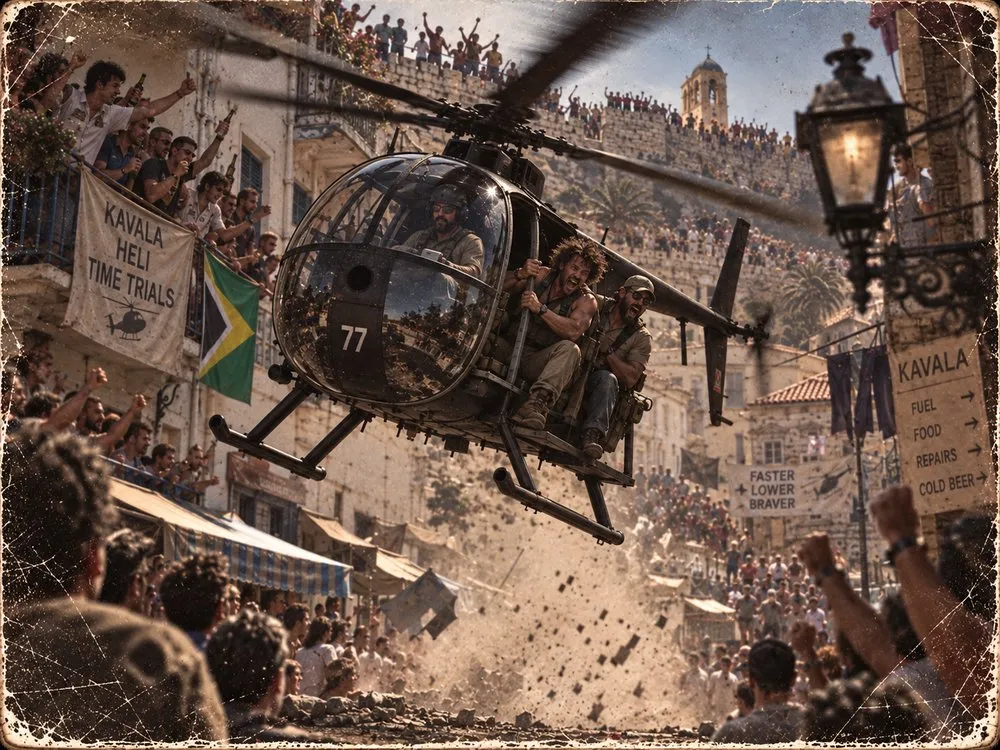 The first public runs drew more spectators with every pass.
The Four-Passenger Rule
The passenger requirement should probably have disappeared when the event became official. Instead, it became sacred. Every timed run must carry four passengers. Exactly why remains unclear. The official rulebook describes them as required occupants. Pilots usually call them ballast.
At first, finding four willing volunteers was easy. The race was new, nobody fully understood the danger, and free drinks were often involved. By the third year, recruitment had become more difficult. Word had spread along with photographs. The rule, however, said only that four passengers had to be aboard when the clock started. It said nothing whatsoever about enthusiasm.
This loophole has shaped Time Trial history almost as much as the ten-metre ceiling. Friends have been bribed. Mechanics have been tricked. Bar bets have been settled. Birthday celebrations have gone badly wrong. One particularly notorious competitor offered what he described as a “free sunrise sightseeing flight” to four tourists who did not discover the nature of the excursion until the timing gate appeared.
For several years, local wisdom held that anyone falling asleep in a Kavala bar during race week should first check whether they were still in the bar when they woke up. The most famous incident occurred when four members of a visiting football club reportedly awoke at dawn already seated on the external benches of a Hummingbird. Two were wearing helmets. One was still asleep. All four had been secured with what the pilot later described as “aviation-grade duct tape.” The pilot defended himself by pointing out that the rulebook never used the word voluntary.
The organisers have reviewed the wording, but declined to change it. The modern rules do now require all passengers to be conscious when the run begins. This was considered a significant safety reform.
Chance Survivor, who has carried some famously unhappy passengers over the years, once offered this advice:
“Never tell ’em the route before takeoff.”
Passengers have since become part of the character of the event. Some scream, some cheer, some spend the entire run gripping the frame and reconsidering every decision that led them there. Experienced passengers lean into turns, watch the rotor tips and occasionally shout warnings the pilot completely ignores. There are even a handful of deranged regulars who willingly return year after year.
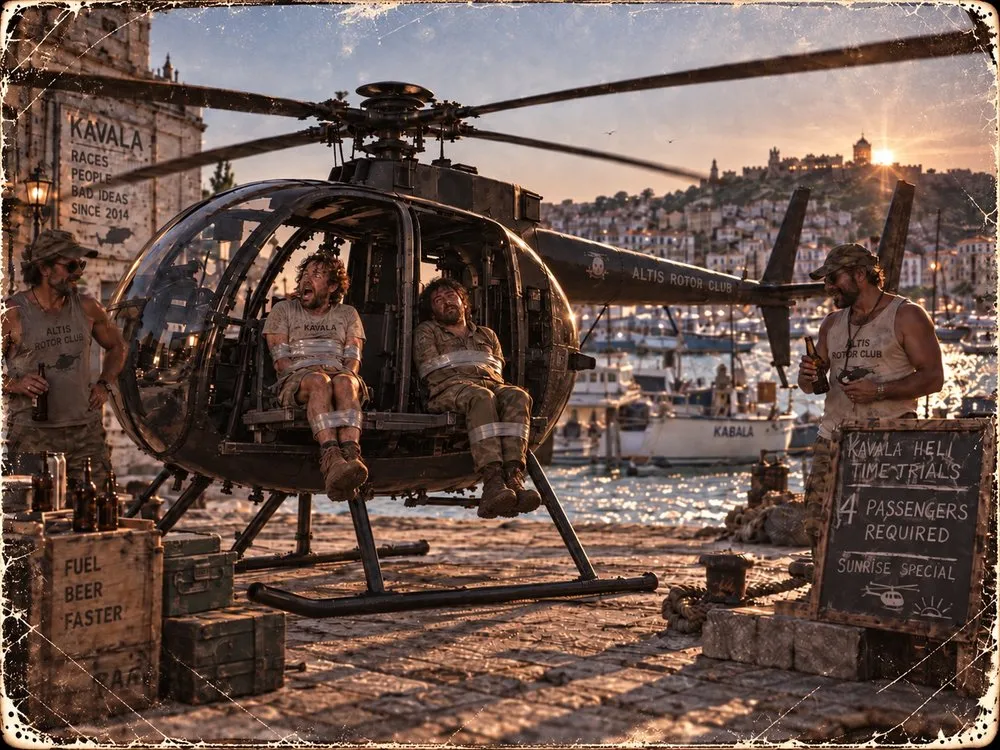 Exactly four passengers: a rule whose origin is murky, but whose enforcement is not.
The Course Begins Fighting Back
The first competitors quickly discovered that Kavala was remarkably well designed for people walking around and remarkably poorly designed for helicopter racing. Lamp posts appeared everywhere. Balconies projected unexpectedly from buildings. Power lines crossed streets. Church towers occupied extremely inconvenient portions of the sky. Trees had been planted with absolutely no consideration for rotor clearance.
The streets themselves varied from comfortably wide to what pilots politely described as “optimistic.” Naturally, these became the most popular parts of the course. The accepted philosophy was simple: anybody could fly a helicopter down a wide road. The question was whether you could put one through a narrow gap without slowing down.
The infamous J. Hooker, whose actual name has been largely forgotten, became an early crowd favourite for attacking corners at absurd speed and throwing the helicopter sideways into violent turns. He rarely flew the same line twice. Sometimes this was even deliberate.
His description of the technique remains one of the most frequently quoted pieces of Time Trial wisdom:
“A J-hook is just an argument between momentum and optimism.”
J. Hooker is credited with proving that several corners previously considered too tight could, in fact, be taken at racing speed. He is also credited with proving that several others could not.
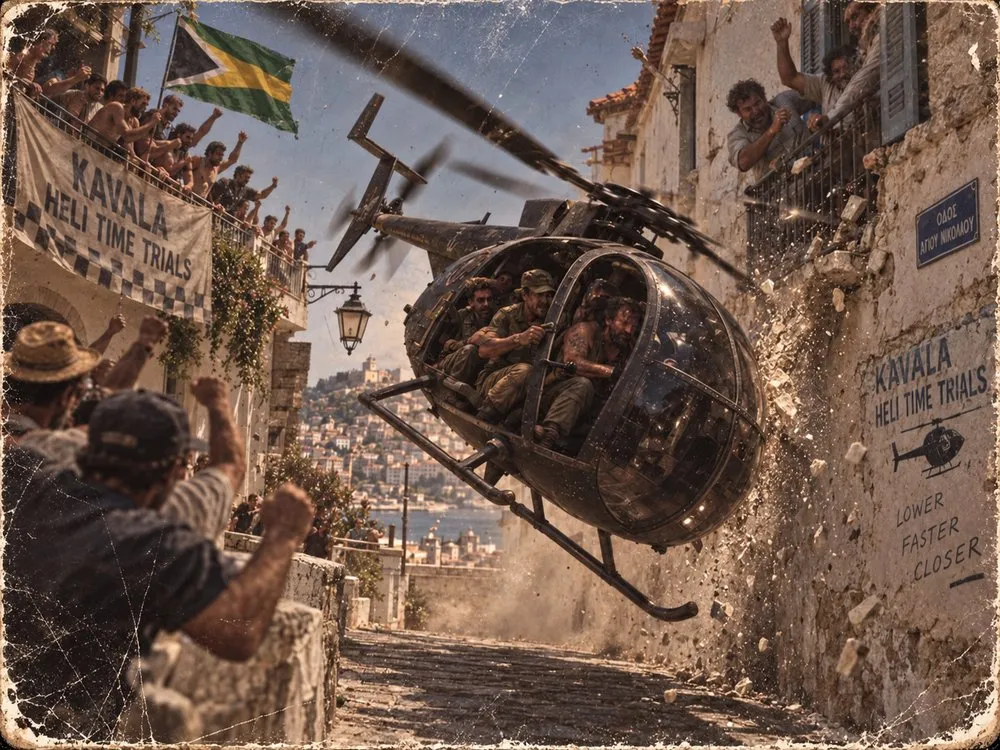 The route rewards careful line choice—but Kavala’s corners have always encouraged optimism.
The Wreck Rule
The first serious crash occurred before lunchtime. A Hummingbird clipped the edge of a rooftop, lost part of a rotor blade and came down heavily in a junction. The pilot and passengers climbed out as the helicopter caught fire. For the first time that day, the organisers were presented with something resembling a safety decision. The possibility of briefly pausing the racing to clear the wreckage was discussed. Then somebody pointed out that the wreck wasn’t completely blocking the road. The next pilot launched.
This established what is now unofficially known as the Wreck Rule. A crashed aircraft is generally left where it comes to rest until the final run is complete. If the wreck completely blocks the route, racing may be briefly paused while enough of it is dragged aside to create a gap. There is no requirement that the wreck be removed. There is certainly no requirement that the fire be extinguished.
Over the years, burning wrecks have become as much a part of the visual identity of the event as timing gates and cheering crowds. Some drivers complain that this gives early competitors an unfair advantage. Most pilots argue that anyone incapable of avoiding a burning helicopter probably wasn’t going to finish anyway.
Chance Survivor, who has finished an impressive number of races and an almost equally impressive number of helicopters, summarized the philosophy:
“If you can still get around it, it isn’t blocking the course.”
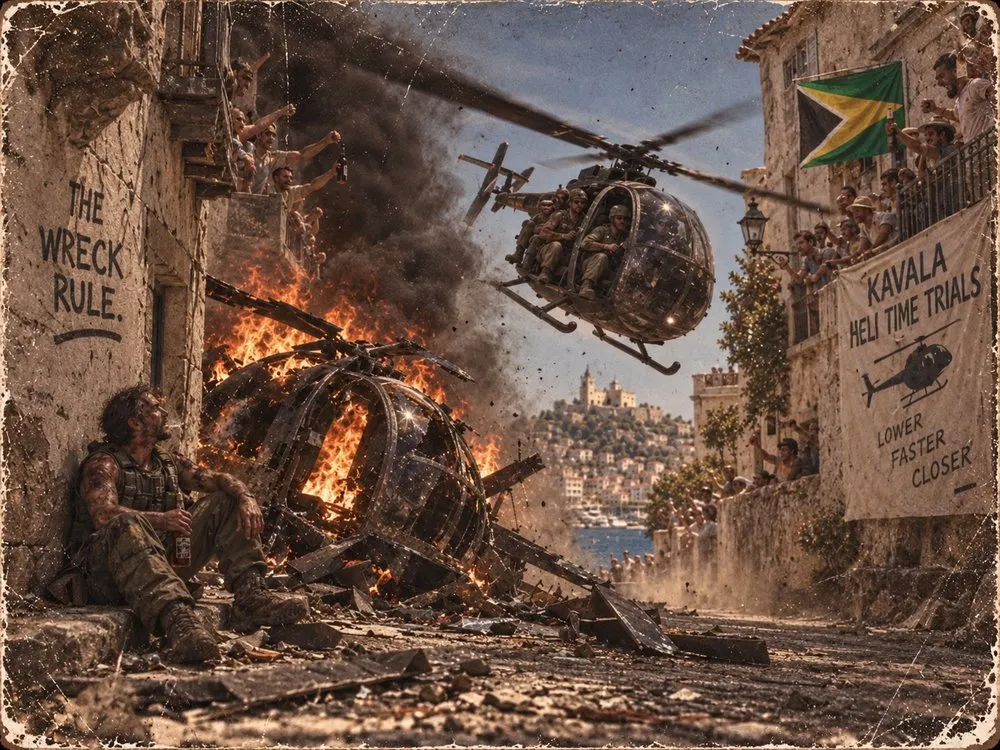 The Wreck Rule: if there is still room to get through, the next run is apparently still on.
An Absolute Disaster
By late afternoon, the inaugural event had become considerably larger than the drunken bet that started it. Several helicopters had been damaged. More than one had been destroyed. Balconies had been clipped. Road signs had disappeared. Street furniture had migrated.
One café lost every umbrella outside it without a single helicopter technically touching the building. A church steeple suffered what the city later described as “minor structural damage” and what pilots described as “additional rotor clearance.”
The Time Trial also produced its first true local celebrity.
Cooter Glidepath, a former military transport pilot, discovered a particularly fast line past the church. It required passing close enough to the steeple that spectators could no longer agree whether the helicopter was going around it or through it. Cooter continued using the line for years.
Asked how he judged the clearance, he replied:
“When the bells get loud, turn left.”
The corner became known simply as Cooter’s.
The name stuck. So did some of his paint and a few chunks of his skids.
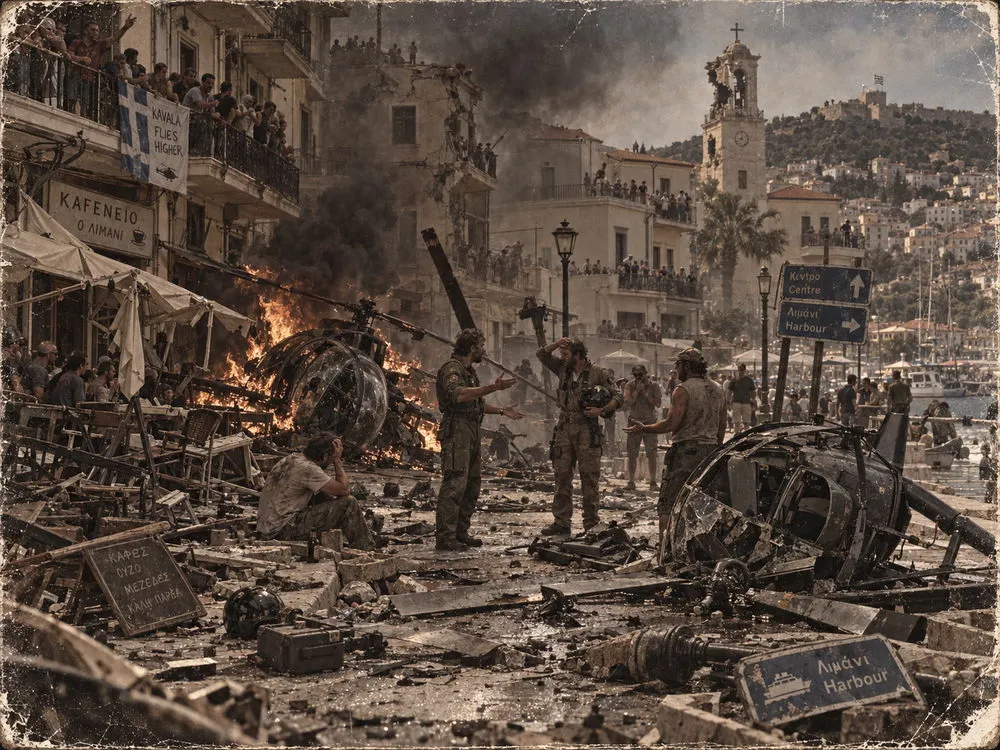 By late afternoon, the inaugural event had left the city with rather more wreckage than it started with.
The Mayor Objects
By sunset, Kavala had experienced what the city council later described as:
“An unprecedented and wholly unacceptable series of aviation-related incidents.”
This was technically accurate. The Mayor was furious. The following morning, his office publicly condemned the event as:
“Reckless, illegal and profoundly stupid.”
This statement appeared in newspapers across Altis. Then the photographs appeared. Hummingbirds sideways between buildings. Rowdy crowds packed onto balconies. Aircraft passing beneath rooftop level. Four passengers clinging to external benches with expressions normally associated with natural disasters. Pilots emerging from wrecks and immediately arguing about whether the run should still count. One particularly famous photograph showed a burning Hummingbird in the foreground while another competitor passed it at speed.
The story spread. People came to Kavala specifically to see where it had happened. Bars, restaurants and hotels filled. Local shops sold photographs, shirts and pieces of wreckage of increasingly doubtful authenticity. The Altis Rotor Club announced that, despite the Mayor’s objections, they intended to hold another event the following year. Tourists began booking a lot of rooms and the Mayor began reconsidering…
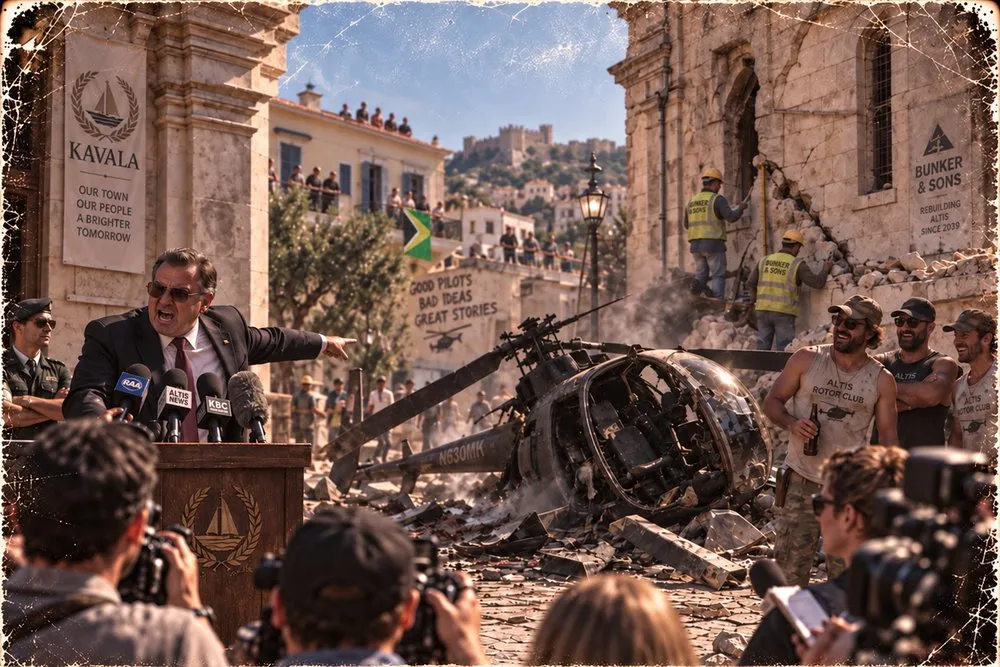 Public condemnation and a sudden boom in tourism can make for an awkward press conference.
The Second Running
The second Kavala Heli Time Trial was officially described as a “closely regulated experimental aviation event.” Nobody from the original race recognized it from that description. The Altis Rotor Club was allowed to organise the event on several conditions. There would be official routes. There would be timing equipment. There would be course marshals. There would be medical personnel. There would be designated spectator areas. And there would be rules.
The pilots agreed to all of this surprisingly quickly. Mostly because nobody had said the rules had to make the race safer. The ten-metre ceiling became official and, importantly, enforceable. Breaking it carried a substantial time penalty. Repeated violations could destroy an otherwise competitive run.
This transformed the ceiling from an informal question of honour into one of the defining tactical elements of the race. A pilot could climb to avoid an obstacle, but he would pay for it. More importantly, the crowd would still boo him. The four-passenger rule was also retained. City officials reportedly suggested removing it. The Rotor Club argued that the additional weight was “part of the challenge.” Officials asked whether passengers needed to volunteer. The Rotor Club asked whether that was strictly necessary. The matter was somehow left unresolved.
Pilots therefore began trading altitude for speed, speed for clearance, clearance for courage and courage for replacement rotor blades. The style of flying now associated with the Kavala Time Trials began to emerge.
Low.
Aggressive.
Fast.
As Beau Low, another early regular, put it:
“If there’s daylight under the skids, you’re wasting altitude.”
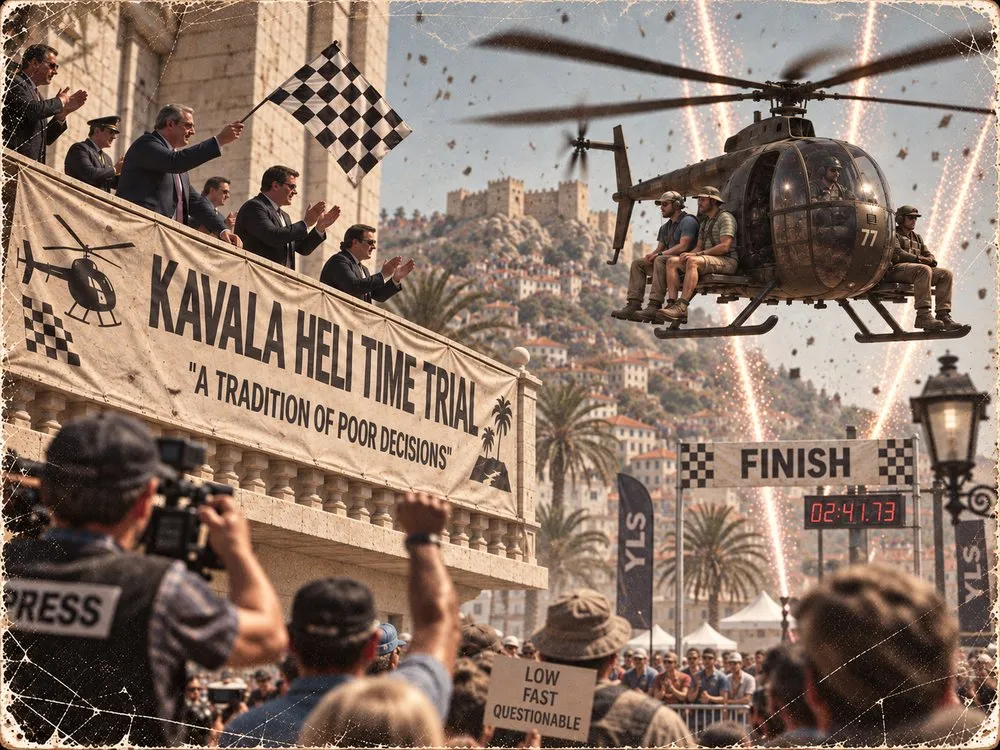 Once the event was sanctioned, the timing gates became official. The questionable decisions remained.
The Little Bird Becomes King
Several helicopter types were tried during the early years. The Hummingbird quickly became dominant. Small, light, responsive and barely wider than some of the gaps pilots were determined to fly through, it suited Kavala perfectly. The aircraft also had another important advantage: there wasn’t much of it. This appealed greatly to Time Trial pilots.
Lil’ Bert, one of the event’s most enthusiastic Hummingbird evangelists, once described the aircraft as:
“Two seats under a ceiling fan.”
The nickname flying lawnchair soon followed. Pilots stripped away anything they considered unnecessary. Doors were particularly unpopular. Some claimed removing them improved visibility. Others claimed it reduced weight. Most simply acknowledged that the doors tended to come off eventually anyway and just got in your way if you needed to bail out.
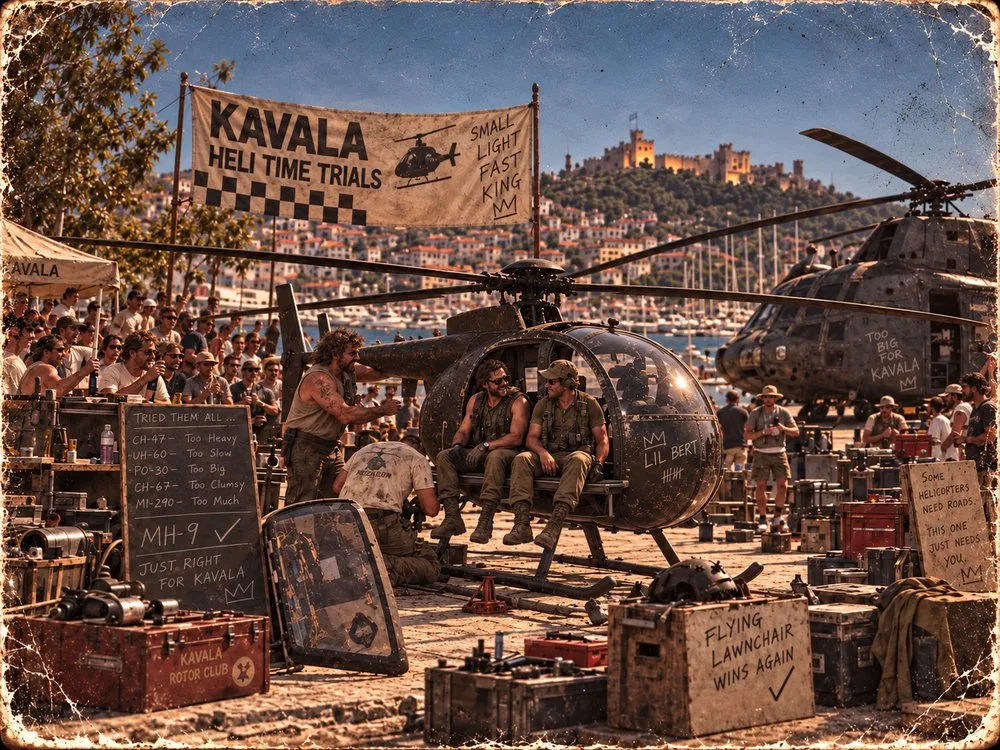 Small and light won out over big and powerful: Kavala is not impressed by your rotor diameter.
The Legends
As the race grew, so did its cast of recurring characters.
Cletus “Collective” McGraw, one of the alleged founders, became famous for a flying style based largely around the belief that anything less than full power indicated a lack of commitment. His mechanical sympathy was legendary for its absence. Asked once why he pulled so much collective coming out of corners, McGraw replied:
“I paid for all the collective. I’m using all the collective.”
His mechanics reportedly hated him. He considered this evidence that they cared. Cletus also developed a reputation for having unusually quiet passengers. Asked how he achieved this, he replied:
“Good knots.”
Stu K. Pedal built his reputation at the opposite end of the controls. Stu’s advice to other pilots, regardless of the actual problem, was usually:
“More left pedal.”
Bad turn? More left pedal. Poor approach? More left pedal. Unexpected yaw? More left pedal. Engine trouble? Probably unrelated, but more left pedal couldn’t hurt.
His most famous comment remains:
“More left pedal has solved every problem I’ve had except divorce.”
His former wife reportedly agrees with half of that statement.
J. Hooker became synonymous with the aggressive hooking turns that remain a defining feature of the race.
His aircraft were recognizable by heavy skid wear, missing paint and an unusually high rate of tail-boom replacement. He insisted that any corner could be taken faster. Asked whether this had ever been proved wrong, he answered:
“Repeatedly.”
Chance Survivor became famous less for outright speed than for the extraordinary number of incidents he somehow walked away from. Chance has finished races without windscreens, without doors, with damaged skids and, on one disputed occasion, with a portion of somebody else’s helicopter attached to his own. He has also become famous for somehow convincing people to ride with him despite this public record.
His philosophy is simple:
“Finish first. Count parts later.”
The phrase has appeared on T-shirts ever since. His passengers have requested equal merchandising rights.
Frank D. Rate became a favourite among visiting pilots after repeatedly blaming poor results on technical performance.
Frank maintains that he has never crashed due to pilot error. His computer simply failed to display the necessary information at the appropriate moment. His defence of one particularly spectacular accident became legendary:
“The helicopter was intact last frame.”
Three of his four passengers dispute this. The fourth says he had his eyes closed.
Dee Sync made much the same argument, although usually about the server.
According to Dee, he has successfully cleared every obstacle in Kavala at least once on his screen. Other witnesses disagree. His most famous defence remains:
“I was nowhere near that building on my screen.”
Then there is Ed Enfield.
Ed began as a course designer and mission tester rather than a serious competitor. He achieved immortality after confidently declaring that a particularly complicated section of the route had been thoroughly tested and was perfectly safe. It failed almost immediately when actual competitors arrived.
His response:
“It worked in Eden.”
The phrase is now traditionally shouted whenever anything during race weekend fails for reasons nobody can explain.
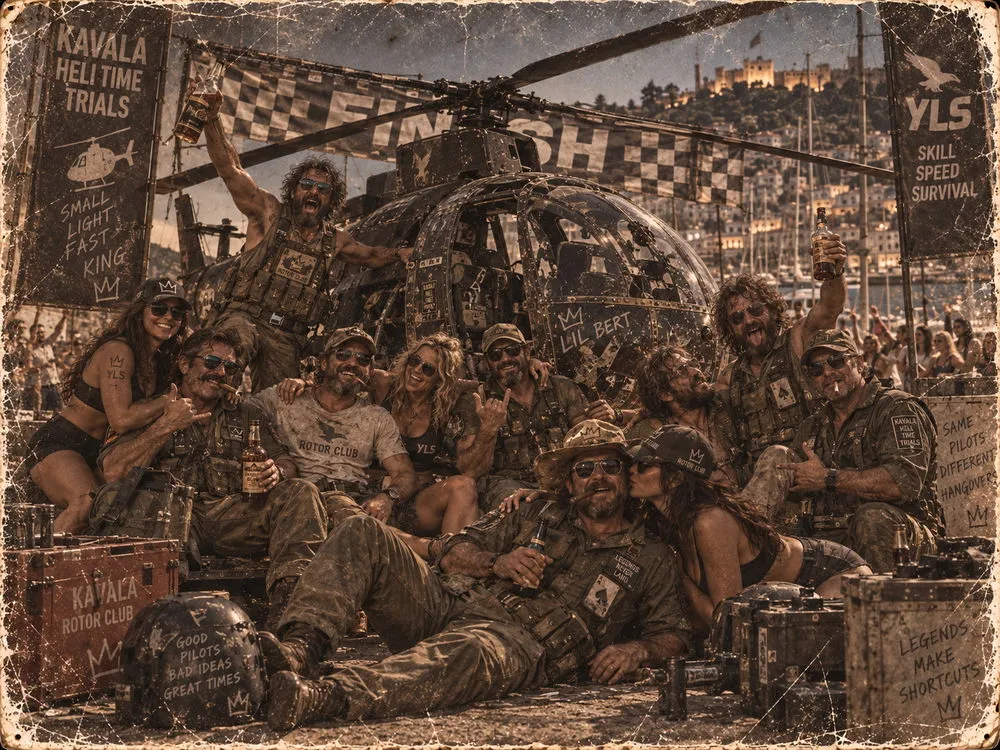 Some of the names in the stories may be exaggerated. The pilots’ confidence is not.
Fireworks
The Time Trial eventually developed one genuinely cheerful tradition. Whenever a competitor sets a new personal best on a route, fireworks are launched in celebration. Nobody is entirely certain when this started. The most popular version claims a local pyrotechnics dealer sponsored the event one year and simply had too much stock left over. Another claims that Cletus McGraw found a crate of fireworks behind a bar and decided a new lap record deserved “something louder.” Either way, the tradition stuck.
Today, a personal best is immediately followed by a burst of fireworks over Kavala. The organisers have been asked whether launching fireworks above a city currently filled with low-flying helicopters is wise. Their official response is that the fireworks are launched after the timed run. This answer has satisfied almost nobody. Drivers who shave only a fraction of a second from their best receive exactly the same celebration as those who smash a long-standing record. A personal best is a personal best.
As Chet “Send It” Mulligan once said:
“If you’re stupid faster than you were yesterday, that’s progress.”
Some pilots claim the fireworks are the best part of the entire event. Others claim the best part is hearing them and knowing they survived long enough to earn them.
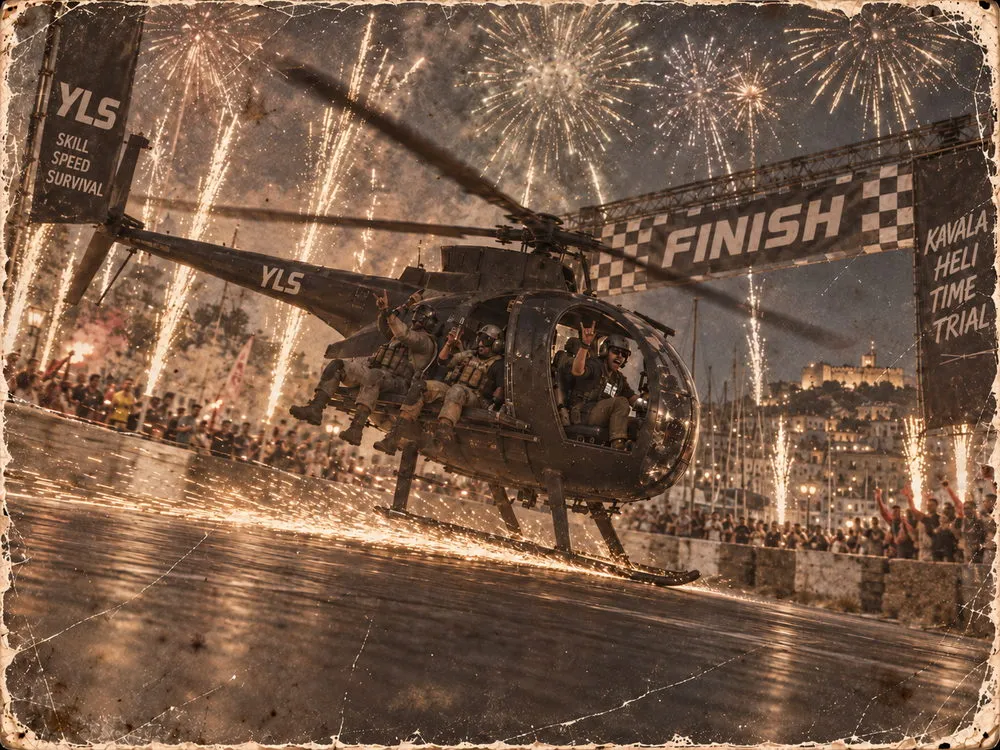 Every personal best gets fireworks. The organisers maintain that the timing is perfectly safe.
The Crowd
The crowds are not passive spectators. Kavala considers itself part of the race. Thousands line the route, occupying barriers, rooftops, windows and balconies.
They cheer low passes, aggressive turns, narrow gaps and successful recoveries. They cheer unsuccessful recoveries even louder. They cheer the fireworks. Showing a somewhat cruel streak, they cheer frightened passengers with unusual enthusiasm. But above all, they boo altitude. A pilot who breaks the ten-metre ceiling will often hear the reaction before seeing the time penalty. The boos follow the aircraft down the street and the pilot well into the night. Competitors have compared it to being pursued by a moving wall of disappointment. This has encouraged pilots to descend earlier than prudence might suggest. The organisers deny that this is dangerous. The organisers deny many things.
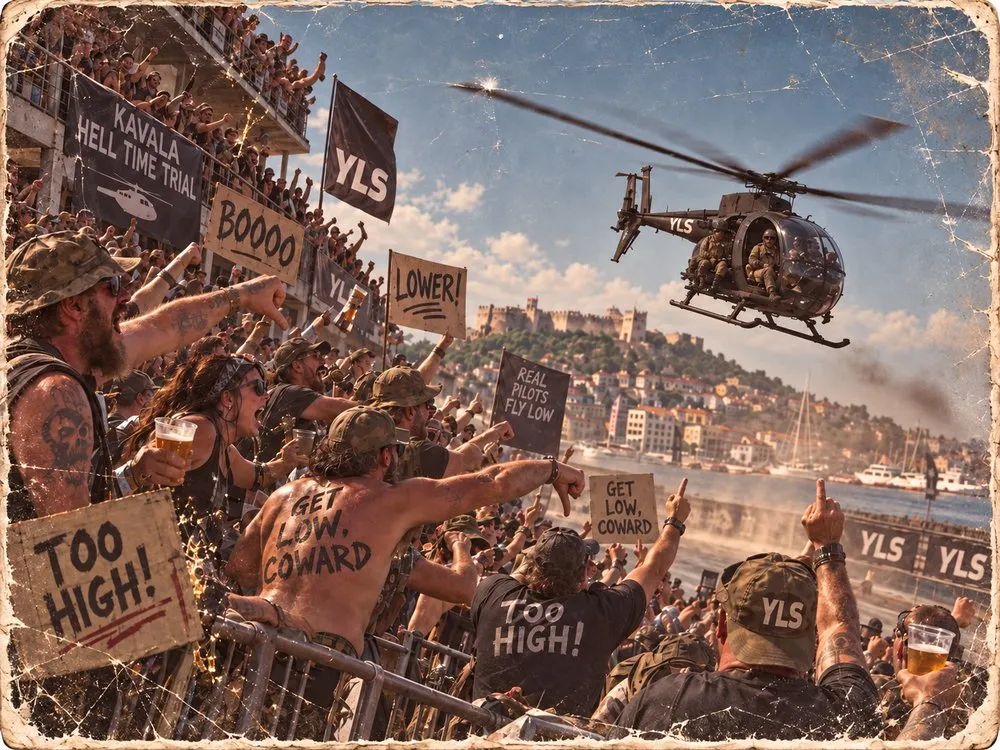 The crowd takes the ten-metre ceiling seriously, even when the pilots do not.
Bunker & Sons
No history of the Kavala Heli Time Trials would be complete without mentioning Bunker & Sons Construction. Bunker & Sons became a sponsor during the early sanctioned years and has remained one of the event’s strongest supporters ever since. The company supplies barriers, temporary structures and various pieces of race infrastructure. It also performs construction work throughout Kavala. Particularly after the Time Trials…
Over the years, Bunker & Sons has repaired walls, roofs, balconies, shopfronts, street furniture and at least one church tower damaged during race weekend. This has led to persistent rumours that the company played some role in persuading the Mayor’s office to permanently sanction the event.
These accusations are completely unfounded. There is no evidence whatsoever that Bunker & Sons bribed anybody to guarantee an annual supply of helicopter-related structural damage. The Mayor’s office has repeatedly confirmed this. Bunker & Sons has repeatedly confirmed this. The Altis Rotor Club has repeatedly been asked to stop laughing when the subject comes up.
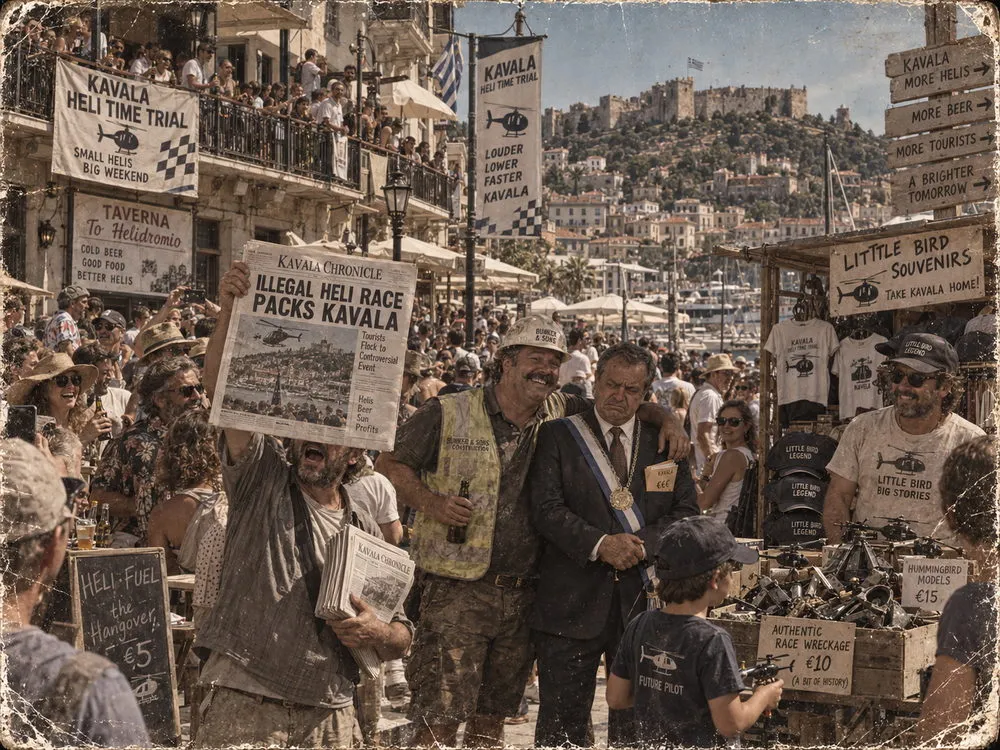 The official denials have never quite matched the scenery behind them.
The company remains a proud sponsor of the event.
Its unofficial slogan among pilots is:
“Concrete always wins.”
Bunker & Sons has also repeatedly denied involvement in the disappearance of several conveniently placed balconies from particularly fast racing lines.
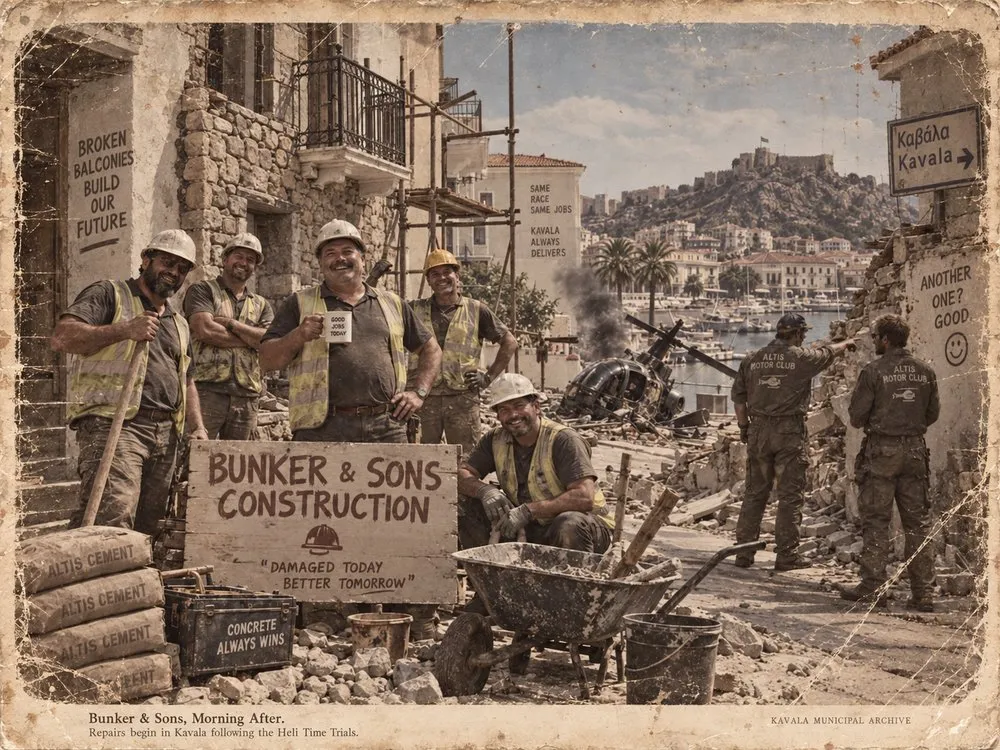 Bunker & Sons: repairing Kavala almost as quickly as the Rotor Club can damage it.
The Modern Time Trial
Today, the Kavala Heli Time Trials bear only a superficial resemblance to that first drunken race.
The timing is professional and the route is properly marked. The crowds are managed. Medical and rescue teams stand ready. Fireworks crews wait for personal bests. The competitors know exactly where they’re supposed to go. And every aircraft arrives at the start line with four passengers. Preferably, but not necessarily, willing.
But the central idea has never changed.
Take a small helicopter. Put four people on it. Put it through Kavala. Stay below ten metres. Go as fast as possible.
It’s now a global event with tourists from all over the world and the Altis News Network broadcasting live. The crowds come because the Kavala Heli Time Trials still feel like what they were on that first morning: a drunken bet that got completely out of hand.
And if you think you have what it takes, strap yourself into a flying lawnchair…
and may your mechanic forgive you.
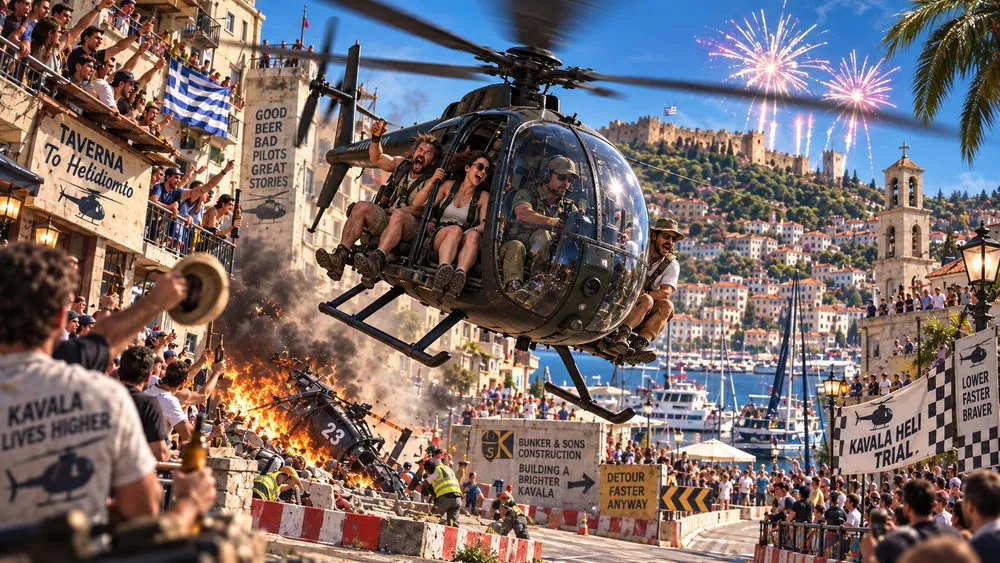 A dubious history, a very real course, and a city that has learned to expect the noise.